




New Trek, Old Problems: Starfleet Academy’s First Two Episodes Reviewed

This week, the latest Star Trek series, Star Trek: Starfleet Academy, premieres with two episodes—and we were eager to review them. After 12 TV series and 14 movies, any new creation is certainly arriving with a galaxy full of baggage. So, how does Starfleet Academy hold up?
The first episode, “Kids These Days,” and the second, “Beta Test,” are, for all intents and purposes, about bringing together the cast of academy cadets for their first semester at the newly reopened Starfleet Academy. The setup is a sequel to Star Trek: Discovery and, in many ways, is a carbon copy—at least from its 32nd‑century visage.

Behind the scenes, Alex Kurtzman, who is responsible for modern‑day Trek, and Noga Landau serve as showrunners.
At the center of the premise is Discovery’s plot point called “the Burn.” About 120 or so years ago, a space baby screamed and destroyed all dilithium—blowing up many dilithium‑powered starships and essentially grounding warp capability. Plot holes large enough to engulf a planet aside, this resulted in many worlds, including Earth, going their own way and leaving the Federation and its space force, Starfleet. Discovery wrapped that all up, reunited Earth with the Federation, and now that warp drive is back, the galaxy is rebuilding what was lost after a century. The last part isn’t a horrible way to build a Star Trek series, but the space‑baby catalyst and the plot holes (i.e., not everyone used dilithium warp drive—see the Romulans) saddle this grand concept with unnecessary backstory.

The first episode starts off strong with a story set fifteen years earlier, when the lead protagonist, Captain Ake (Holly Hunter), is forced to send a pirate (Paul Giamatti) and the woman helping him to prison. The problem is that the woman also has a young son, Caleb Mir—who tricks Ake and escapes, despite the captain pledging to help him. This leads to Ake resigning from Starfleet and becoming a teacher on Bajor. Now, fifteen years later, Starfleet has found Caleb and has asked Ake to become the chancellor of Starfleet Academy and captain of the Academy’s starship, the USS Athena. She agrees—if Caleb comes along as one of the new cadets.
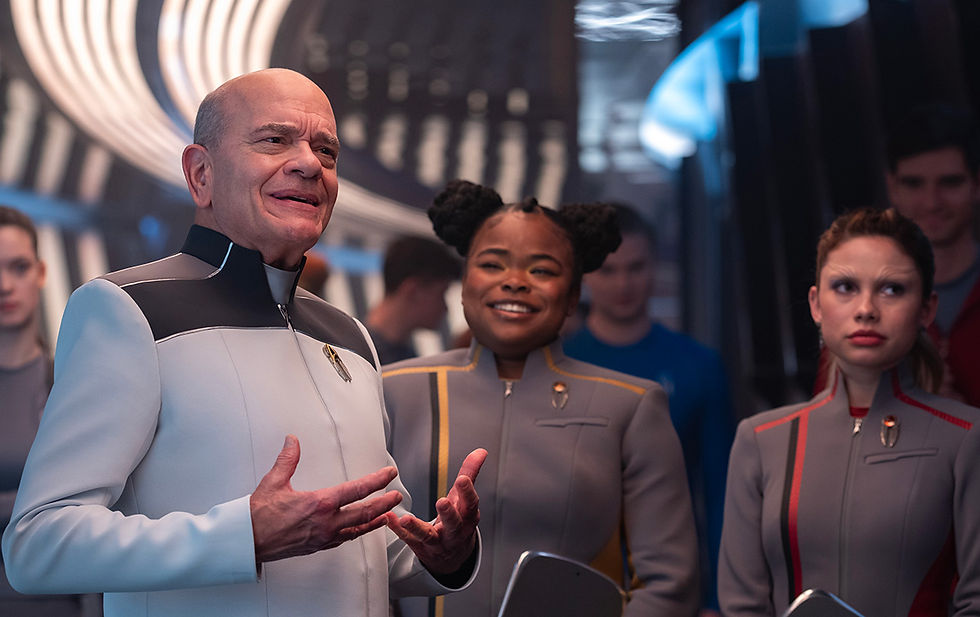
The first episode follows the journey to Earth and the subsequent intercept of the Athena by space pirates led by Giamatti’s Nus Braka, the part‑Klingon, part‑Tellarite nemesis who has a bone to pick with Captain Ake for sending him to space prison. The adults run a training simulation to trick Braka and the pirates after they board the Athena to steal its warp drive, while the cadets work together to save the ship from programmable matter (magic tech) encasing it. Everything comes together, and the ship arrives at the new Starfleet HQ in San Francisco.

There are no real standouts among the cadet characters. Voyager’s Doctor (Robert Picardo) is a main cast member, and the first officer is a part‑Klingon, part‑Jem’Hadar woman named Lura Thok (Gina Yashere), who reminds you a little of SNL’s Leslie Jones in alien makeup. Honestly, Thok is one of my favorite characters of the new batch—hopefully they delve into her backstory and how Jem’Hadar, who are grown in test tubes and only male, can procreate with other aliens.
Like Star Trek: Discovery, the “treknobabble” is largely glossed over, and the series suffers from too much “just accept it” when it comes to science and reasoning—also a problem with Discovery. When characters talk about Trek staples like shields, subspace anomalies, starship operations, and the like, it’s clear they—and I mean the writers—are coming from the perspective of casual fans who have seen a few episodes of Berman‑era Trek and are trying to fake it. For example: Where is ship’s security when the pirates attack? Where did the crew go after the attack? The first officer, critically wounded, is left with just our cadets. Yet a few scenes later, one of the cadets randomly summons the Doctor to help her with a plot point. Even the attack on the Athena, while beautiful from an FX perspective, doesn’t quite make sense. From a Star Trek point of view, the writing is bad. In some cases, I’d argue worse than Discovery—and that’s saying something.

However, the pilot episode does have good parts, and overall it comes off as a decent venture into 32nd‑century Star Trek. We see Captain Ake, who feels like a cross between a college professor and a starship commander, and she has a number of quirks—like walking around barefoot. While she is part Lanthanite (Kurtzman‑era Trek’s answer to aliens who live a long time in human terms), it seems strange she would jettison her long Starfleet career because of one incident where she separated a kid and his mom when the mom was involved in a murder. And yes, like all Kurtzman‑era Trek, we have to delve into the wokeness and bring modern‑day issues into a story set 1,000 years later. Ake’s strange passion for finding and bringing Caleb with her seems a little unhealthy at first (although actor Sandro Rosta spends a lot of time shirtless in these two episodes, and we’re not complaining), but the writers reveal at the end that Ake’s son died in “the Burn,” putting a very Star Trek spin on her motivation for saving Caleb. Although she should really blame Star Trek: Discovery’s bad writers, not herself, for the death of her son. But I digress.
Building off the flawed but decent first episode, the second is where the series really shines. Sorry—just kidding. The second episode, “Beta Test,” goes into full Star Trek: 90210 territory, as others have lamented (although I never saw Beverly Hills, 90210, so I have to compare this to Star Trek: Dawson’s Creek, but without Kevin Williamson’s writing). Other than the names of characters and places, this episode doesn’t feel at all like Star Trek. It bounces between regurgitating Caleb’s “will he stay or will he go” nonsense that we resolved in the first episode, to quirky kids on their first day at school, to the Betazoids lowering Trump’s wall—er, their psionic wall—and rejoining the Federation. An appearance by Discovery’s Tig Notaro as Jett Reno is wasted, and Caleb’s love interest, the daughter of the Betazed president (played by Zoe Steiner), has a Trek‑character feel to her in a way most of the others don’t. This episode doubles down on the “these are kids from our time in the 21st century as 32nd‑century cadets” vibe. At times, there is so much slapstick and teen drama that you wonder if you accidentally switched to an episode of Saved by the Bell.

Speaking of Caleb Mir, I like the actor and character both—but after two episodes he’s very close to Mary Sue territory, the same problem that plagued Michael Burnham for most of Discovery. These are ensemble shows now. That’s what works. And for goodness’ sake, don’t take the exact opposite approach either, where Caleb messes up every episode, eventually gets himself out of hot water, but still gets a tongue‑lashing from Ake. We’re two for two with that theme, for those keeping count.
Worse than Discovery is the writing of the characters with modern‑day dialogue. None of the characters—save for the Doctor and Admiral Vance (also popping up from Discovery)—sound like space explorers 1,000 years from now. A Betazoid character says “bros,” people use profanity and derogatory language from modern day, and even the mannerisms come off as kids in costumes, not actors playing roles in the distant future.
Bad writing of Star Trek elements is amplified here. Captain Ake seems to dislike wearing a Starfleet uniform—or, as previously mentioned, shoes—as she’s seen multiple times in a slinky black dress. Scenes meant to be funny—Ake repeatedly changing seats to avoid the Doctor—seem out of place for Star Trek. And does anyone remember who the Betazoids are? Again, I think the writers saw Deanna Troi and thought she was a full Betazoid. Turns out, no—she’s half Betazoid. Betazoids can read most humanoids’ thoughts, not just their emotions. And what is wrong with the Betazoid president? Is he deaf? Is that why he appears to use sign language? After 1,000 years, we haven’t found a technical solution for that? Too bad he can’t just read minds—oh, right. In reality, this was just another 21st‑century concept forced into a story that didn’t need it, using a crowbar to hit the nail on the head to say, “Deaf people are real people too!” Or something. This is what people call “woke.” I’ve said before I hate that term, but I understand what critics mean when they use it.
Like the first episode, the second doesn’t serve the characters well. In many ways, it feels like the writers of the second episode were given a few plot points from the first but didn’t really know what was going to have transpired, so they were forced to reintroduce everything again.
Some characters, like Klingon Jay‑Den Kraag (played by Karim Diane), didn’t get much screen time, but he’s clearly one of the more interesting characters, and I’d like to see more of him. Even the hologram “Sam,” who I speculated would be annoying in every scene, comes off as a potential Data/Spock‑style outsider, but never gets beyond the perception of a schoolgirl looking for her homeroom on the first day of school.
Even Robert Picardo’s Doctor, who for a brief second seemed poised to delve into real Trek territory—considering he’s lost everyone he (and, in character terms, we) knew from the good old days—is instead shrugged off and used mostly for comic relief.
The only disappointing character is Darem Reymi, played by George Hawkins. His backstory seems to be that his wealthy family paid his way into Starfleet, and he’s the stereotypical teenage bully. To borrow our Saved by the Bell metaphor again—he’s Slater early on.
The other character I’d like to see gone is the strange girl who seemingly ate her combadge. This isn’t funny. Neither is the girl who runs away crying when Thok yells at her. This is kowtowing to 21st‑century sensibilities—nothing more.

The music is largely forgettable. If there’s a theme, I didn’t pick up on it. Similarly, the opening credits were boring and uninspired. They could’ve really done a Star Trek opening, but this felt like a rejected mash‑up of Discovery and Picard Season One’s openings. The use of “San Francisco” did, however, hit all the right notes and ironically did what Star Trek: Enterprise tried and failed to do: bring a modern song into Trek in a way that didn’t feel ham‑fisted or out of place.
The series has tons of callbacks to previous Treks. Playing Star Trek Bingo with the number of memberberries would be fun—just no drinking games, please. As I said, lots of nods. My favorites are the Exocomps (from TNG and Lower Decks) and the Brikar cadet who looks very similar to Rok‑Tahk from Prodigy. In fact, the line that had me smiling the most is when Sam talks to the Doctor about his adventures and mentions some of the Prodigy kids. When the Kurtzman era of Star Trek closes, I’m certain the only beloved elements that will be embraced by fans are Star Trek: Picard’s third season and Star Trek: Prodigy—not just because of the TNG or Voyager crews, but because, out of everything modern Trek has produced, they feel like the previous 60 years of Trek that came before.
The most cringeworthy moment of all best describes Star Trek: Starfleet Academy—and all of Alex Kurtzman’s vision of Star Trek—when the cadet character Reymi says, “I’m a Khionian, bitch.” Berman‑era Trek went to incredible lengths to ensure their characters’ dialogue was timeless and that our heroes maintained Gene Roddenberry’s vision of humanity doing and being better. Well, it seems like 1,000 years from now, we’ve had a few setbacks in that department.

For “Kids These Days,” I’ll give it 3 out of 5 combadges. For “Beta Test,” I’d fail it, but I’ll be gracious and give it 1 out of 5.
A little epilogue about the Star Trek 60th‑anniversary intro: it featured starships from the series’ history but left out quite a few. I get it—there’s a time factor and likely a cost factor to get every ship every fan would want. Included were the TOS Enterprise, the Enterprise‑A, Enterprise‑D, Defiant, Voyager, NX‑01, Discovery, SNW Enterprise, and the Athena.
There doesn’t seem to be any specific criteria (all TV‑show ships, all hero ships, etc.).
Noticeably absent were the Enterprise‑E, the Cerritos, the Protostar, and I would even say the Titan/Enterprise‑G. The Enterprise‑E technically had much more screen time than the Enterprise‑A, and the Cerritos, Protostar, and Titan were all hero ships for their respective series (granted, Titan/Enterprise‑G was just one season).
Regardless, it was a cool opening and doesn’t need a controversy surrounding it. Though the Enterprise‑E would’ve been good to see again.
All photos from Paramount+
Comments